




A research team led by Shanghai Jiao Tong University Global College(SJTUGC, abbreviated as GC)Associate Professor Yulian He has published a paper titled “Linear Scaling Relationships between Relative Diffraction Peak Intensity and Catalytic Oxidation of Light Alkanes” in the international journal ACS Catalysis. Through experiments and machine learning, the team proposed for the first time a novel method that utilizes the relative diffraction peak intensity from routine XRD measurements to rapidly identify highly active crystal facets in polycrystalline catalysts. This provides an efficient and universal experimental criterion for studying structure-performance relationships in surface-sensitive catalytic reactions.
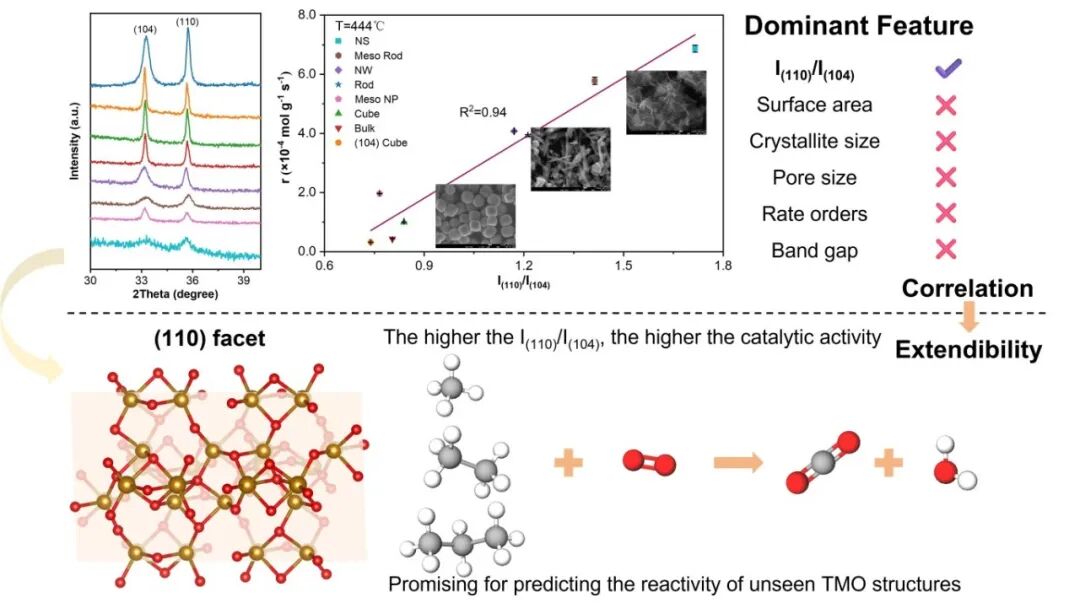
Transition metal oxide catalysts play a significant role in energy conversion and environmental catalysis, with their activity often determined by the exposed crystal facets. However, precisely identifying the dominant active facets in polycrystalline materials has long posed experimental and theoretical challenges, traditionally relying on complex and expensive surface science techniques and theoretical simulations. To address this challenge, the research team systematically synthesized eight α-Fe2O3 samples with different morphologies as a model catalyst. They discovered a strong linear correlation (R2 ≈ 0.9) between the XRD relative peak intensity ratio I(110)/I(104) and the catalytic lean-burn activity for methane. This relationship remained robust under different temperatures and space velocities, and its dominant role was validated through various statistical methods including Pearson correlation, permutation importance, and greedy deletion. Combined with characterization techniques such as XPS, Raman, EPR, and CH4-TPSR, the study further revealed that the I(110)/I(104) ratio not only reflects the preferential exposure of the (110) facet relative to the (104) facet but is also significantly correlated with oxygen vacancy concentration, thereby jointly promoting the activation of C–H bonds and O2. Moreover, this linear relationship also applies to the catalytic lean-burn reactions of ethane and propane, indicating a consistent mechanistic dominance of the (110) facet in light alkane oxidation. The proposed method enables rapid assessment of surface-active facets and prediction of catalytic performance for polycrystalline catalysts using only routine XRD measurements, circumventing the need for complex model construction and advanced in situ characterization required in traditional studies. This provides a powerful tool for the rational design and high-throughput screening of catalysts.
Yulian He is the sole corresponding author of this journal article. Yuan Gao, a GC Ph.D. student enrolled in 2022, is the first author. Co-second authors include Master’s student Mengyao Bao and Ph.D. student Changquan Zhao of the 2024 batch at GC.
Author Introduction
Yuan Gao
Ph.D. student (enrolled in 2022), Global College, Shanghai Jiao Tong University.
Research interests: Methane catalytic oxidation, AI-assisted materials design.
Mengyao Bao
Master’s student (enrolled in 2024), Global College, Shanghai Jiao Tong University.
Research interest: Methane dry reforming.

Changquan Zhao
Ph.D. student (enrolled in 2024), Global College, Shanghai Jiao Tong University.
Research interest: AI-assisted catalyst design and optimization.

Yulian He
Yulian He is an Associate Professor jointly appointed by the Global College and the School of Chemistry and Chemical Engineering at Shanghai Jiao Tong University, and serves as a doctoral advisor and the head of the Catalysis and AI Laboratory. Her research focuses on closed-loop interdisciplinary research in heterogeneous catalysis integrating experiment, theory, and AI. She received her B.S. in Chemistry from Nankai University in 2016, her Ph.D. from Yale University, USA, in 2020, and conducted postdoctoral research at Stanford University, USA. She has been selected for the Shanghai Sailing Program and the Shanghai Leading Talent (Overseas) Program. To date, she has published over 40 papers in high-impact international journals, including J. Am. Chem. Soc. (4), PNAS (2), and Nat. Commun. (1); authored 4 book chapters; and serves as a youth editorial board member for several journals.


